
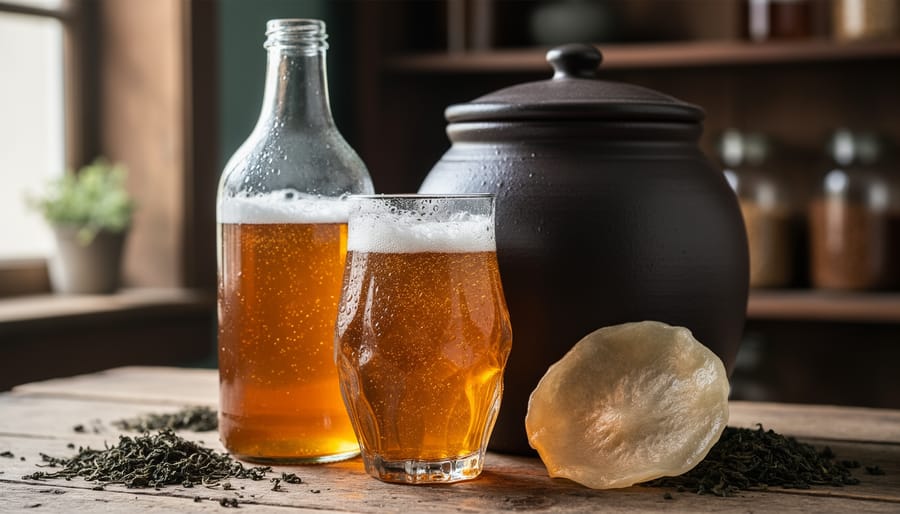
Kombucha is a fermented tea beverage that originated in northeastern China around 220 BCE during the Qin Dynasty, where it was prized for its invigorating and detoxifying properties. This sparkling, slightly tart drink has traveled an extraordinary path across continents and centuries, evolving from an ancient Chinese tonic into a global beverage phenomenon that’s equally at home in health food stores and craft cocktail bars.
Understanding where kombucha comes from isn’t just a history lesson. The drink’s traditional preparation methods, rooted in that original Chinese fermentation process, directly inform how modern brewers approach everything from starter culture selection to flavor development. When you trace kombucha back to its source, you discover why specific techniques matter and how the beverage’s spread through Russia and Eastern Europe in the early 20th century shaped the brewing traditions many enthusiasts follow today.
The story behind kombucha also reveals something broader about how beverages cross cultural boundaries. What began as a medicinal drink in ancient China transformed as it moved westward, picking up new names, preparation styles, and serving customs along the way. For today’s beverage enthusiasts, whether you’re mixing kombucha into creative cocktails or brewing batches at home, knowing this origin story adds depth to every glass. It connects modern drinkers to a fermentation tradition that’s weathered millennia, proving that some of the best drinks don’t need reinvention, just rediscovery.
This article will walk you through kombucha’s verifiable historical roots, explain the fermentation science that’s remained consistent since those early Chinese dynasties, and show how geography shaped the drink we recognize in 2026.
What Kombucha Origine Means
The term “kombucha origine” reflects a growing curiosity among beverage enthusiasts about where this fermented tea truly began. While “origine” is simply the French and international word for “origin,” its appearance in searches signals a deeper interest in tracing kombucha back to its authentic roots, beyond the trendy health drink shelf and into its historical and geographical beginnings.
- Kombucha origine
- The French term for kombucha’s origin, now widely used in international searches about this fermented tea’s historical and geographical roots.
- SCOBY
- Symbiotic Culture of Bacteria and Yeast, the living culture that transforms sweetened tea into kombucha through fermentation.
- Qin Dynasty
- The Chinese dynasty (221-206 BCE) during which the earliest documented kombucha consumption appeared, around 220 BCE in northeastern China.
- Origin designation
- The verified geographical and historical source of a beverage or food, which influences authentic preparation methods and ingredient selection.
Understanding kombucha’s origin matters for more than historical curiosity. Geographical origin claims directly influence how the beverage should be prepared, which ingredients are considered traditional, and what flavor profiles are authentic versus modern innovations. When we know that kombucha originated in northeastern China over 2,000 years ago, we can distinguish between time-tested fermentation techniques and contemporary shortcuts.
There’s an important distinction between a beverage’s geographical origin and its cultural heritage. Kombucha began in China around 220 BCE, but as it spread along trade routes to Russia, Eastern Europe, and Germany by the early 20th century, each region developed its own preparation traditions and flavor variations. These aren’t competing origin claims, they’re chapters in kombucha’s journey across continents. The Chinese origin remains the documented starting point, while Russian and European traditions represent cultural adaptations that emerged centuries later.
For today’s home brewers and kombucha enthusiasts, understanding origine means recognizing which practices connect to ancient methods and which are modern interpretations. It shapes ingredient choices, fermentation times, and flavor expectations, linking every batch brewed in 2026 back to that original northeast Chinese tradition.
The Ancient Chinese Roots: 220 BCE and the Qin Dynasty

The earliest documented evidence of kombucha consumption places the beverage in northeastern China around 220 B.C., during the reign of the Qin Dynasty. This historical marker, now over 2,000 years old, represents the most reliable starting point we have for tracing kombucha’s origins, though the actual practice may extend even further back into undocumented antiquity. The Qin Dynasty period was itself a transformative era in Chinese history, marked by the unification of warring states and significant developments in trade, agriculture, and cultural exchange, conditions that may have facilitated the spread and refinement of fermented beverages like kombucha.
Historical accounts from this period describe kombucha as valued specifically for its invigorating and detoxifying effects, a reputation that has persisted through millennia and still drives much of the beverage’s appeal in 2026. The focus on revitalization and cleansing suggests that early Chinese consumers viewed kombucha not merely as refreshment but as a functional beverage with perceived health benefits. This aligns with the broader Chinese tradition of integrating medicinal properties into everyday foods and drinks, where the line between nourishment and treatment was deliberately blurred.
What we don’t know is nearly as significant as what we do. The historical record provides no detailed preparation instructions from this early period, leaving us uncertain about the exact tea varieties used, fermentation durations, sweetening agents, or how the symbiotic culture itself was cultivated and maintained. We can reasonably infer that tea, which was already established in Chinese culture by 220 B.C., formed the base, and that some form of natural sweetener and fermentation vessel would have been necessary. But the specifics remain lost to time.
Kombucha’s emergence in northeastern China fits within a much larger tradition of Chinese fermented beverages spanning thousands of years. The Chinese had already mastered fermentation techniques for rice wine, grain-based drinks, and various preserved foods, creating a cultural foundation where experimenting with fermented tea would have been a natural progression rather than a revolutionary leap. This context matters because it positions kombucha not as an isolated discovery but as one expression of a sophisticated fermentation knowledge base that had been developing across Chinese cuisine for centuries before the Qin Dynasty.
How Kombucha Works: The Fermentation Process Behind the Origin Story
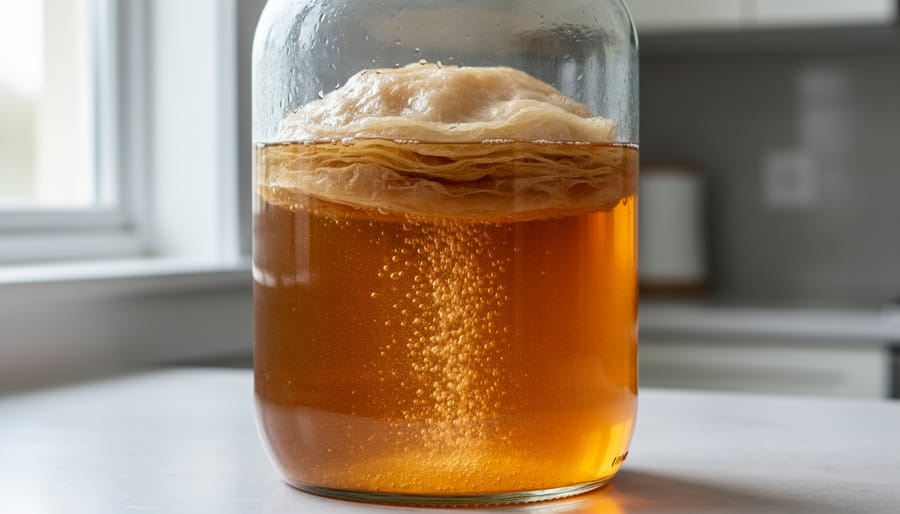
Understanding how kombucha forms helps explain why this beverage emerged where it did. The process centers on a living culture called a SCOBY, a symbiotic culture of bacteria and yeast that looks like a rubbery pancake floating atop sweetened tea. This organism-colony consumes the sugar and converts it through two simultaneous fermentation pathways: yeast breaks down sugar into alcohol and carbon dioxide, while acetic acid bacteria transform that alcohol into organic acids, primarily acetic and gluconic acid. The result is a tangy, slightly effervescent drink with minimal residual alcohol.
The transformation typically takes seven to fourteen days at room temperature. As the SCOBY metabolizes the sweetened tea, the liquid becomes progressively more acidic, dropping from roughly pH 4.5 to pH 2.5 or 3.0. This acidity preserves the beverage naturally and creates the characteristic sharp flavor that balances the remaining sweetness. The carbon dioxide produced during fermentation gives kombucha its gentle fizz, especially when sealed during a second fermentation stage.
This process makes perfect sense in the context of ancient China’s tea-growing regions. Tea itself contains polyphenols and nitrogen compounds that support microbial fermentation, while the warm, humid climate of northeastern China provided ideal temperature conditions for SCOBY activity. The culture could survive and replicate easily, passing from batch to batch, a crucial advantage in pre-refrigeration eras when preservation techniques determined which foods and beverages became cultural staples.
The elegance of kombucha fermentation lies in its self-regulating nature. The acids produced protect against pathogenic bacteria, creating a stable ecosystem where beneficial microbes thrive. This biological safety mechanism, combined with tea’s availability and sugar’s preservative properties, is what makes kombucha special among fermented beverages, and why it survived two millennia without modern sterile brewing equipment.
Kombucha’s Journey West: From China to Russia and Beyond
Kombucha’s migration from northeastern China follows the ancient pathways of trade and cultural exchange that connected Asia to the West. While the beverage’s 220 BCE origins are well-documented, its westward journey took nearly two millennia to fully materialize, moving along routes where tea, spices, and fermentation knowledge regularly crossed borders.
The Silk Road likely served as kombucha’s primary corridor out of China, though the exact timeline remains murky. Trade caravans carrying tea, sugar, and fermentation cultures created ideal conditions for the beverage’s spread. As kombucha moved through Central Asia, it encountered different water sources, climate conditions, and tea varieties, which inevitably shaped regional variations. Each culture that adopted the drink adapted it to local ingredients and taste preferences, creating subtle differences in flavor profiles and preparation methods.
By the early 20th century, kombucha had established itself in Russia, where it gained significant popularity. Russians embraced the tangy, effervescent brew as a health tonic, often preparing it at room temperature in homes throughout the country. The beverage’s foothold in Russia proved particularly strong, with families passing down SCOBY cultures across generations. From Russia, kombucha continued spreading to other parts of Eastern Europe and Germany, where it found receptive audiences familiar with fermented foods like sauerkraut and kvass.
This westward expansion reveals how fermented beverages travel along cultural networks rather than straight geographical lines. Kombucha succeeded where populations already understood fermentation principles and valued functional drinks. The beverage’s adaptability to different tea traditions, whether green tea in its Chinese homeland or black tea in European preparations, demonstrated a flexibility that helped it cross cultural boundaries while maintaining its fundamental character as a living, fermented drink.
Types of Kombucha Origin Claims and Traditions
Over the past two millennia, kombucha’s journey from northeastern China has spawned numerous origin stories and distinct regional traditions. While the 220 BCE Qin Dynasty records provide the earliest documented evidence, alternative claims have emerged as the beverage migrated along trade routes and adapted to new cultures.
The most persistent alternative origin story attributes kombucha to Dr. Kombu, a Korean physician who allegedly introduced the fermented tea to Japan’s Emperor Inkyo around 414 CE. However, this narrative lacks verifiable historical documentation and appears to be later folklore attempting to explain the beverage’s name. The actual etymology of “kombucha” remains debated, some scholars link it to the Japanese word for kelp tea (kombu-cha), which is an entirely different beverage, while others trace it to Chinese transliterations.
As kombucha spread across continents, each region developed distinctive preparation approaches that reflect local ingredients and cultural preferences:
- Chinese medicinal tea culture: Long fermentation periods, emphasis on digestive and detoxifying properties, typically using green or oolong teas
- Russian and Eastern European folk preparation: Shorter fermentation cycles, sweeter flavor profiles, often called “tea kvass” (chaynyy kvas) and integrated into daily household routines
- German health movement adoption: Systematic brewing protocols developed in the 1920s-1930s, focus on probiotic benefits and standardized SCOBY cultivation
- Contemporary Western craft brewing: Experimental flavoring with fruits and botanicals, emphasis on carbonation levels, commercial scalability and consistent flavor profiles
These regional variations extend beyond flavor to fermentation philosophy. Traditional Chinese methods prioritized medicinal potency through extended aging, sometimes lasting months. Russian brewers favored accessibility and quicker turnaround for family consumption. Modern Western producers balance traditional techniques with food safety standards and shelf-stable packaging requirements.
The coexistence of these traditions demonstrates that while China’s 220 BCE origin stands as the documented starting point, kombucha’s identity has been shaped by centuries of cross-cultural adaptation rather than a single monolithic tradition.
How Understanding Kombucha’s Origin Influences Modern Brewing

Understanding kombucha’s 2,000-year Chinese origins changes how serious brewers approach the craft today. The historical preference for long fermentation periods, often weeks rather than days, produces the complex, layered flavors that differentiated traditional kombucha from simple sweetened tea. Modern home brewers who how to make kombucha benefit from extending fermentation beyond the commercial standard of 7-10 days, sometimes reaching 14-21 days for depth that mirrors ancient preparations.
Tea selection reveals another origin-informed principle. Northeastern China’s historical use of black and green teas from Camellia sinensis provides the template for authentic flavor profiles. Commercial producers often substitute cheaper tea blends or add fruit concentrates early in the process, but traditional methods call for quality loose-leaf tea and patience. The SCOBY culture itself, when maintained properly, carries microbial lineages that can be decades old, connecting modern batches to historical brewing traditions through living organisms.
Ancient Chinese brewers prioritized the drink’s functional properties over sweetness, fermenting until most sugars converted and the tang intensified. This contrasts sharply with today’s commercial kombucha, often halted at higher residual sugar levels (2-6 grams per serving) for mainstream palatability. Home brewers who master fermentation timing can replicate the drier, more vinegar-forward character prized in traditional preparations.
The origin story also informs quality assessment. Authentic kombucha shows visible SCOBY formation, natural carbonation from secondary fermentation, and that characteristic sour-sweet balance, not artificial flavoring or forced carbonation. Temperature control matters too; historical brewing likely occurred at ambient temperatures (68-78°F), which modern brewers can replicate for consistent results. Recognizing these ancient principles helps distinguish genuine fermented tea from flavored beverages marketed as kombucha.
Frequently Asked Questions About Kombucha’s Origins
Where did this fermented tea really come from? The origin questions surrounding kombucha often lead people down various historical rabbit holes, so here’s what the documented record actually tells us.
Where did kombucha originate?
Kombucha originated in northeastern China during the Qin Dynasty around 220 BCE, making it over 2,000 years old. This represents the earliest available report of kombucha consumption, though the beverage likely existed in some form before written documentation.
What was kombucha originally used for?
Ancient Chinese records indicate kombucha was valued for its invigorating and detoxifying effects. The beverage’s reputation as a functional drink with health benefits dates back to these earliest documented uses.
How did kombucha spread beyond China?
Kombucha traveled westward along trade routes, reaching Russia and Eastern Europe by the early 20th century before expanding to Germany and eventually worldwide. This migration happened gradually over centuries as cultures adopted and adapted the SCOBY fermentation journey to their local tea traditions.
Are there other origin stories besides China?
While various folklore and alternative theories exist, the Chinese origin during the Qin Dynasty remains the only claim supported by historical documentation. Other regional stories often reflect cultural adaptations rather than independent origins.
Understanding where kombucha comes from matters more than you might think. When you know the beverage emerged from a specific time and place with particular preparation methods, you gain context for evaluating modern versions. The 2,000-year-old tradition from northeastern China established fermentation practices and flavor profiles that authentic kombucha still follows today, distinguishing traditional brews from heavily processed commercial alternatives.
Kombucha’s journey from ancient China to your local grocery store spans more than two millennia, and understanding that timeline changes how we approach this fermented tea today. The 220 BCE Qin Dynasty origin stands as the earliest documented evidence we have, rooting kombucha firmly in northeastern China’s tea-growing regions and fermentation traditions. That foundation isn’t just historical trivia, it explains why certain preparation methods work, why tea selection matters, and why patience during fermentation produces better results than rushing the process.
The beverage’s remarkable migration from China through Russia, Eastern Europe, and Germany shows how adaptable fermentation traditions can be while retaining their core character. Each culture that adopted kombucha added its own twist, yet the fundamental process, SCOBY, tea, sugar, time, remained constant. Today’s global kombucha market, with its endless flavor variations and commercial production methods, still relies on that ancient Chinese discovery of controlled fermentation.
When you brew kombucha at home or choose a bottle at the store, you’re participating in a craft that predates most modern beverages by centuries. Consider exploring traditional long-fermentation approaches rather than rushing to bottle after a week. Look for brands that respect the historical process and use quality tea as their base. Understanding where kombucha came from helps you recognize authentic preparation, appreciate the beverage’s functional benefits beyond mere refreshment, and connect with a fermentation tradition that has endured precisely because it works.